
Argentina faces a World Cup sprint in Baku
The Sub-15 tournament promises 950 matches in six days, with small pitches, 20-minute halves and a schedule that leaves little room for comfort.
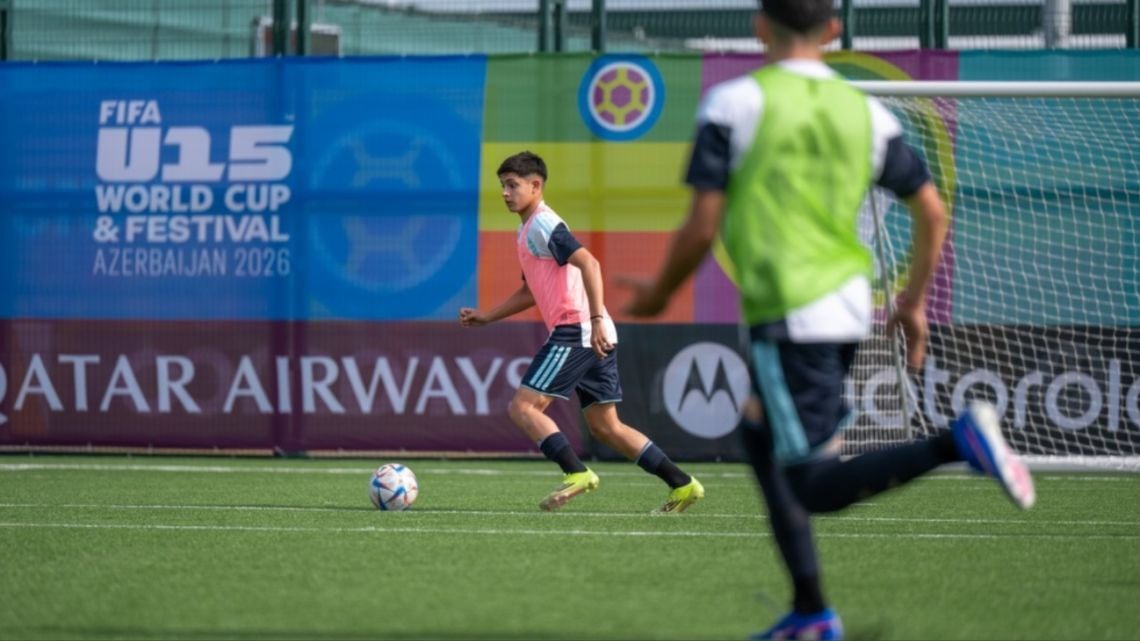
In this tournament, the biggest obstacle may not be the rival. It is the calendar. Argentina arrives in Baku for the first FIFA Sub-15 World Cup and Festival with five matches in 72 hours. The referee, on the other hand, will probably still have time to check whether the ball went in.
The competition brings together 189 national associations and nearly 3,000 players. It starts on Saturday, October 24, in Baku, capital of Azerbaijan. All teams play in the group stage, with no early elimination, but the format is far from familiar.
A different kind of World Cup
There are 32 groups, named from A to AF. Each team plays every opponent in its group once. The group winners move to Level A, which will determine the world champion. The remaining teams go to Levels B, C, D, E or F. From there, the competition becomes a direct-elimination stage, with placement matches still on the agenda.
The field is also smaller, and that is no accident. Teams may field eight players, including the goalkeeper. Matches consist of two 20-minute halves, with five minutes of rest between them, on pitches measuring 68 by 47 meters. Rosters can include up to 14 players born in 2011 or 2012.
That setup favors speed, technique and short bursts of concentration. It also turns the tournament into a true endurance test: the entire event will be completed in seven days, with a maximum of two matches per day for each national team. Nearly 950 games in six days. In a football context, the calendar is asking players to sign a waiver before kicking a ball.
- Argentina opens against Algeria on Saturday, October 24, at 2:00 a.m., Argentina time.
- On Sunday, October 25, it faces Chinese Taipei at 5:45 a.m. and Oman at 12:30 p.m.
- On Monday, October 26, it plays Suriname at 4:30 a.m. and Malawi at 11:15 a.m.
- Adrián Gallará leads the Argentine delegation and has been in charge of the AFA's youth divisions since 2017.
Argentina's arrival has another challenge: the team must handle an unusual number of time zones, short recoveries and a demanding group-stage schedule. The group may be manageable on paper, but paper has never had to play a match at 2:00 a.m. nor explain sleep deprivation to a 14-year-old.
For Gallará, the task will be to prepare a squad for a competition that demands rapid adaptation. The reduced field and playing time can make the games less predictable. The compressed program, meanwhile, can expose physical and mental gaps more quickly than a traditional tournament.
Does the format favor experienced teams? That is the debate. In my view, the schedule removes much of the advantage of having a settled squad. Any advantage belongs to the team that can recover, think clearly and compete when fatigue is already negotiating on its behalf.
“Lo que viene: Argentina begins its World Cup on Saturday, October 24, against Algeria.”Federico Alderete, Deportes
The first edition begins Saturday, October 24, and Argentina's challenge will be to survive the clock as much as the opponents. That is what comes next.
Te puede interesar